Foreword
This document is drafted in accordance with the provisions of GB/T 1.1-2020 "Guidelines for Standardization Work Part 1: Structure and Drafting Rules for Standardization Documents".
This document was proposed and managed by Shandong Biological Fermentation Association.
This document was drafted by Shandong Saigao Group Coration.
The main drafters of this document: Liu Shanshan, Xia Rui, Jia Yanjun, Yu Zhihong, Jia Yanqing, Cao Rui, Wang Guihua.
D-Allulose
1 Scope
This document specifies the technical requirements, hygienic requirements during the production, inspection methods, inspection rules, marking, packaging, transportation and storage of D-Allulose.
This document applies to D-Allulose.
2 Normative references
The following documents are indispensable for the application of this document. For dated references, only the dated version applies to this document. For undated reference documents, the latest version (including all amendments) applies to this document.
GB 14881 National Food Safety Standard — General Hygienic Practice for Food Production GB 15203 Starch sugar
GB/T 191 Packaging–Pictorial markings for handling of goods
GB 2760 National Food Safety Standard — Standard for Uses of Food Additives
GB 2762 National Food Safety Standard — Maximum Levels of Contaminants in Foods GB 31637 Edible starch
GB 4789.2 National Food Safety Standard — Microbiological Examination of Total Bacterial Count for Food Hygiene
GB 4789.3 National Food Safety Standard — Microbiological Examination of Coliform Bacteria Count Food Hygiene
GB 5009.11 National Food Safety Standard — Determination of Total Arsenic and Inorganic Arsenic in Foods
GB 5009.12 National Food Safety Standard — Determination of Lead in Foods
GB 5009.3 National Food Safety Standard — Determination of Moisture in Foods
GB 5009.3 4 National Food Safety Standard — Determination of Sulfur Dioxide in Foods GB 5009.4 National Food Safety Standard — Determination of Ash Content in Food
GB 5749 Standards for Drinking Water Quality
GB/T 601 Chemical Reagent – Preparation of Reference Titration Solutions
GB/T 602 Preparation of Standard Solution for Determination of Impurities
GB/T 603 Preparation of Reagent Solutions for Use in Test Methods
GB /T 6682 Water for Analytical Laboratory Use—Specification and Test Methods
3 Terms and Definitions, Chemical Name, Molecular Formula, Structural Formula, Relative Molecular Mass
3.1 Terms and Definitions
D-Allulose
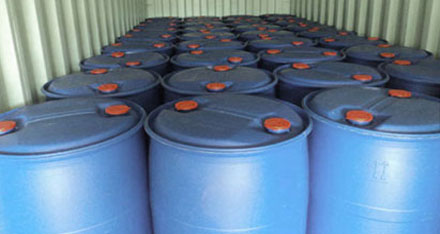
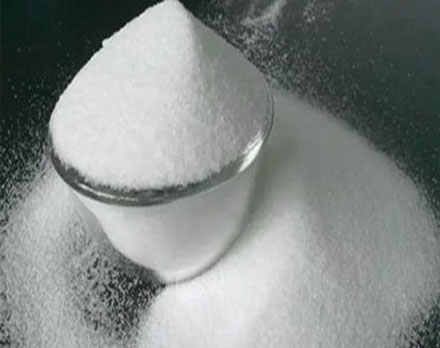
It is a liquid or crystalline solid product with the epimer corresponding to the third carbon of D-fructose as the main component, which is made from edible starch or starch sugar through enzymatic conversion, purification and separation, and refining.
3.2 Chemical name
D-Allulose (D-Allulose, D-Psicose)
3.3 Molecular formula

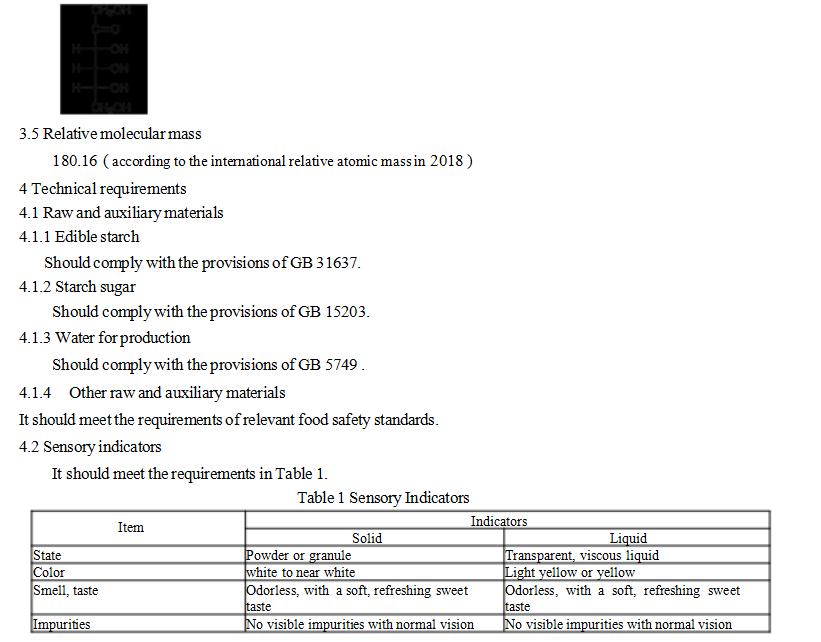
3.4 Structural formula
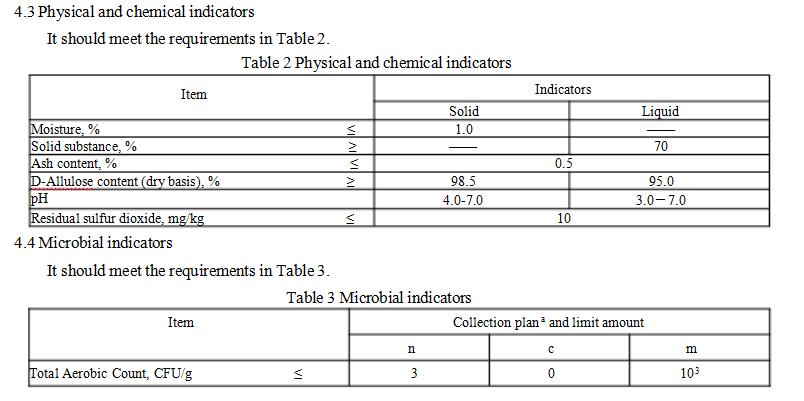
5 Food Additive Requirements
Should comply with the provisions of GB 2760.
6 Hygienic requirements for production and processing
Should comply with the provisions of GB 14881.
7 Inspection method
7.1 General requirements
The water used in this document shall comply with the water specifications in GB/T 6682 unless other requirements are specified; the reagents used shall refer to analytical reagent unless other specifications are specified. The standard titration solution, standard solutions for impurity determination, preparations and products used in the analysis shall be prepared according to the provisions of GB/T 601, GB/T 602 and GB/T 603 unless other requirements are specified.
7.2 Sensory test
7.2.1 Liquid
Take an appropriate amount of sample and put in a colorless, clean, dry beaker , put it in a bright place, observe its color and state, and check whether there are impurities visible in normal vision; take an appropriate amount of sample to smell its taste, put it in the mouth and taste it (Before the second sample taste, you should rinse your mouth with water), and make records.
7.2.2 Solid
Take an appropriate amount of sample and put it in a clean and dry container. Under suitable natural light, observe the color and state of the sample to check whether there are any impurities visible to the naked eye ; Before the second sample taste, you should rinse your mouth with water), and make records.
7.3 Physical and chemical tests
7.3.1 Moisture
Should apply Karl Fischer method in GB 5009.3 .
7.3.2 Solid
7.3.2.1 Instruments and equipment
7.3.2.1.1 Abbe refractometer: Accuracy is 0.0001 units.
7.3.2.1.2 Glass Rod: The end is bent and flattened.
7.3.2.2 Instrument Calibration
At 20°C, the refractive index of the refractometer with testing water is 1.3330, which is equivalent to zero content of dry matter (solid matter). The instrument is calibrated at least once a day.
Analysis steps: place the refractometer in a place with sufficient light, adjust the temperature of the refractometer prism to 20°C, separate the two prisms, add a small amount of sample (1-2 drops) to the fixed prism surface with a glass rod (the glass rod must not touch prism surface, and the sample coating time should be less than 2 seconds ) , immediately close the prism and stay for a few minutes to allow the sample to reach the temperature of the prism. Adjust the spiral of the prism until the field of view is divided into light and dark parts, turn the compensator knob to eliminate iridescence and make the dividing clear line between light and dark, continue to adjust the spiral and align the dividing line between light and dark on the cross line, and read the solid content from the scale, and then re-read immediately, take the average as a measurement value. Clean and dry the two prisms, and perform the second measurement on the same sample as above. Take the arithmetic mean of the two times and report the result.
7.3.2.3 Precision
The absolute difference between two independent measurement results obtained under repeatability conditions should not exceed 1% of the arithmetic mean.
7.3.3 pH
7.3.3.1 Instruments and Equipment
pH meter: the accuracy is 0.01pH, equipped with glass electrode and calomel electrode (or combination electrode).
7.3.3.2 Analysis steps
Debug and calibrate the pH meter according to the instrument instruction manual.
Take an appropriate amount of sample, and prepare a test solution with about 30% dry matter in boiled and cooled water with a pH of 5.0-7.0. Then, rinse the electrode probe with water, dry it gently with filter paper, then insert the electrode into the sample solution, adjust the temperature regulator so that the temperature indicated by the instrument is the same as the temperature of the solution, and do the reading when stable. The result is expressed to one decimal place .
7.3.3.3 Precision
The absolute difference between two independent measurement results obtained under repeatability conditions should not exceed 3% of the arithmetic mean.
7.3.4 Ash content
Measured according to the method specified in GB 5009.4 .
7.3.5 D-Allulose content
Measured according to the method specified in Appendix A.
7.3.6 Residual amount of sulfur dioxide
Measured according to the method specified in GB 5009.34.
7.4 Microbiological test
7.4.1 Total Aerobic Count
Measured according to the method specified in GB 4789.2.
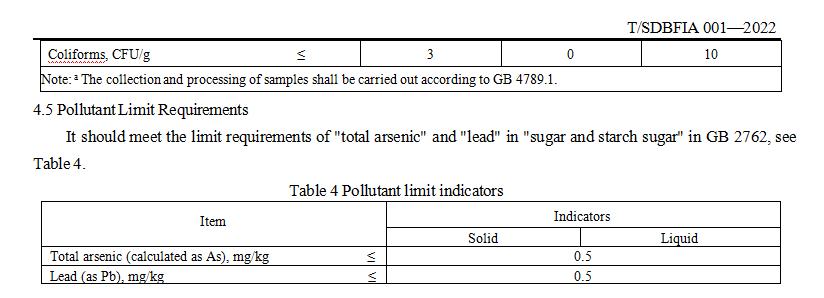
7.4.2 Coliforms
Measured according to the method specified in GB 4789.3.
7.5 Inspection of pollutant limit
7.5.1 Lead
Measured according to the method specified in GB 5009.12.
7.5.2 Total Arsenic
Measured according to the method specified in GB 5009.11.
8 Inspection rules
8.1 Batch formation and sampling
8.1.1 Batch formation
The products with uniform quality, which are continuously produced with the same raw materials, the same formula, the same process and on the same production line, are a batch.
8.1.2 Sampling
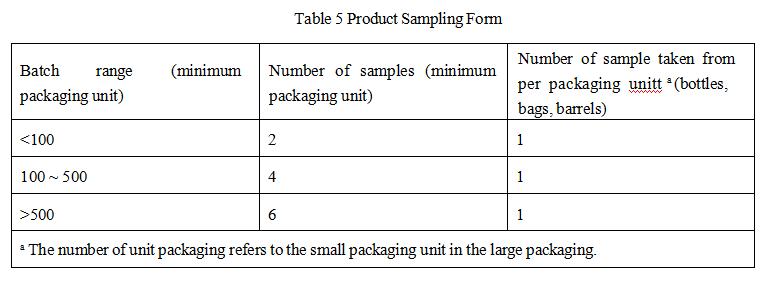
8.1.2.1 The inspection of each batch of products shall draw samples according to Table 5.
8.1.2.2 Every tank truck loaded with products must be inspected.
8.1.2.3 Samples from tank trucks and barreled products should be taken from 10cm below the liquid level, and the sampler should comply with relevant regulations.
8.1.2.4 According to the principle of equal sampling from each sample, each sample volume of products in tank trucks shall not be less than 1kg; each sample volume of product in drums shall not be less than 1kg; each sample volume of product in bottles and bags shall not be less than 600g.
8.1.2.5 Use a clean and dry sampling tool to place the samples in three clean and dry containers, seal them,
and indicate the product name, batch number, sampling time, and the name of the sample-taking person, etc.
One for physical and chemical testing, one for microbiological testing, and another is sealed for future
reference.
8.2 Inspection
8.2.1 Factory inspection
8.2.1.1 Before leaving the factory, the products should be carried out batch by batch according to the
regulations in this document, and the products can only leave the factory after the inspection meets the requirements of this document.
8.2.1.2 Factory inspection items
——Liquid products: sensory, solid substance content, D-Allulose content, pH, total number of colonies, coliform bacteria;
——Solid product: sensory, moisture, D-Allulose content, pH, total number of colonies, coliform bacteria.
8.2.2 Type inspection
The type inspection items are all the items in the requirements of this document. Generally, the type inspection is once every six months. In one of the following situations, the type inspection should also be carried out:
a) When there are major changes in raw and auxiliary materials;
b) When changing key processes or equipment;
c) When the production of the trial-produced product or the normal product is stopped for more than three months, and the production is resumed;
d) When there is a large difference between the factory inspection result and the previous type inspection;
e) When required by relevant laws and regulations.
8.3 Judgment rules
8.3.1 After sample inspection, all inspection items meet the requirements, and it is determined that the product complies with this document;
8.3.2 If one or two of the inspection items do not meet the requirements, twice the amount of samples should be taken from the same batch of products for re-inspection, and the re-inspection results shall prevail. If there is still one item that does not meet the requirements, it is determined that the batch of products does not meet the requirements of this document. If there are three or more items in the inspection results that do not meet the requirements, it is determined that the batch of products does not meet the requirements of this document. If one of the microbiological indicators does not meet the requirements, it is determined that the batch of products does not meet this document.
9 Marking, packaging, transportation, storage
9.1 Marking
The pictogram of product packaging, storage and transportation should meet the requirements of GB/T
191.
9.2 Packaging
9.2.1 The packaging container should be clean and undamaged.
9.2.2 For tank trucks transporting liquid products, the tank truck should be special for the use.
9.3 Transportation
9.3.1 The means of transport should be clean;
9.3.2 It should not be mixed with toxic, harmful, corrosive and odorous items, and should be protected from moisture, pressure, and exposure to the sun. It should be handled with care when loading and unloading, and the packaging should not be directly hooked.
9.4 Storage
9.4.1 The product should be stored in a ventilated, dry and clean warehouse, and exposure to the sun and rain is strictly prohibited. Fire is strictly prohibited.
9.4.2 It should not be stored together with toxic, harmful, corrosive and odorous items.
Appendix A
Measurement of D-Allulose content
A.1 Reagents
a) Water: Ultra-pure water;
b) D-Allulose standard product, purity ≥ 95%, prepare 6 standard solution series with different
concentrations within the range of 0.1 mg/mL to 10 mg/mL.
A.2 Instruments
a) High-performance liquid chromatography (equipped with refractive index detector and constant column-temperature system);
b) Mobile phase vacuum filtration degassing device;
c) Analytical balance (accuracy 0.0001g ) ;
d) Quantitative loop;
e) Microsampler 50µL or 100µL.
A.3 Reference chromatographic conditions
a) Chromatographic column: 6.5mm×300mm calcium-type cation exchange resin chromatographic
column or other equivalent chromatographic column.
b) Mobile phase: Ultra-pure water;
c) Detector temperature: 40°C;
d) Column temperature: 85°C;
e) Flow rate: 0.5mL/min;
f) Injection volume: 10µL;
g) The above chromatographic conditions can be adjusted according to the actual situation.
A.4 Draw standard curve
Under the above-mentioned chromatographic conditions, the standard solution of D-Allulose was used to inject samples respectively, and a standard curve was made based on the concentration of the standard sample versus the peak area. The linear correlation coefficient should be above 0.9990.
A.5 Preparation of sample solution
Weigh an appropriate amount of liquid or solid sample (the content of various sugars should be within the
linear range of the standard curve in A.4), dissolve in water to a volume of 50mL and mix well, filter with a
0.22μm or 0.45μm microporous membrane, and the filtrate is used as the The test solution is ready for use.
Note: The sample can be diluted according to the requirements of the standard curve range, and the dilution factor is recorded as D.
A.6 Sample determination
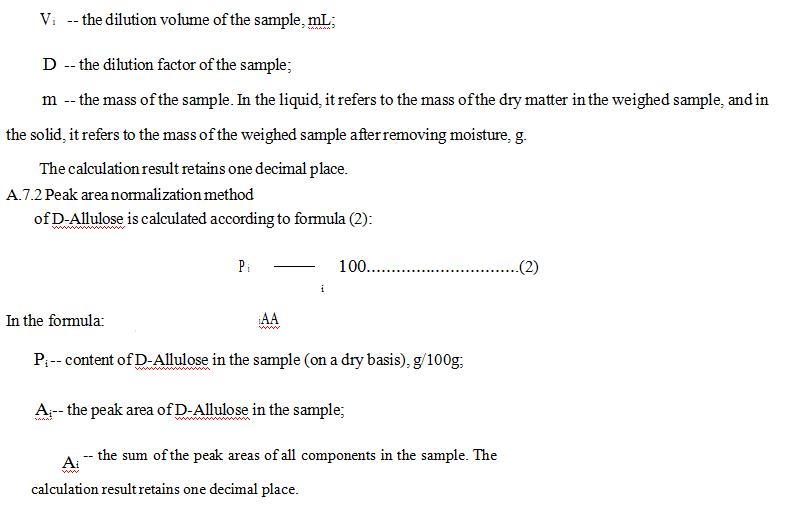
Inject the prepared sample solution, and characterize the chromatographic peak of D-Allulose in the sample according to the retention time of the standard. Calculate the content of D-Allulose by external standard method or area normalization method (external standard method is the arbitration method).
A.7 Calculation of results
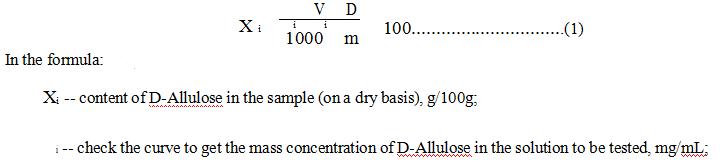
A.7.1 External standard method
of D-Allulose is calculated according to formula (1):
A.8 Precision
The absolute difference between the two independent measurement results obtained under repeatability measurement conditions shall not exceed 5% of the arithmetic mean value.